

AKWAABA - Welcome to Ghana, the safest, friendliest, most affordable, English- speaking country in Africa

H.E. Gina Ama Blay
Ambassador of the Republic of Ghana to the Federal Republic of Germany
AMBASSADOR OF THE REPUBLIC OF GHANA - GERMANY
Welcome
I warmly welcome you to the website of the Embassy of the Republic of Ghana in the Federal Republic of Germany. In addition to Germany, the Embassy is concurrently accredited to the Republics of Estonia, Latvia, and Lithuania. As you explore this site, you will discover more about Ghana and understand why it is often described as a ‘model democracy’ in Africa.
Here, you will find useful information about Ghana, her history, people, culture, geography, politics, tourism, and economy as well as her enabling business environment which makes her one of the ideal investment destinations in Africa.
In addition to information on our consular services, there is an array of quick links to other relevant state institutions which you may explore. Ghana’s beautiful, diverse and colorful tourism attractions also await you.
There are currently Ghana Honorary Consul offices in Hamburg, Hannover, Dortmund and Munich which provide consular services (Business Visas and related services) in those areas. We are in the process of appointing a new Honorary Consul for Frankfurt. However, clients who require consular services in cities other than those mentioned above will be served in Berlin.
It is an honour for us in the Embassy to work towards deepening Ghana’s bilateral relations with the Federal Republic of Germany and the countries of concurrent accreditation as well as serving you in the best way possible. Therefore, I encourage you to feel free to send in comments, questions and/or suggestions/ideas on how to improve upon our services.
You are most welcome to explore Ghana here!
Gina Ama Blay
Ambassador
PUBLIC NOTICE
Embassy of Ghana, Berlin – Holiday Closure Notice
08th April, 2024
PUBLIC NOTICE
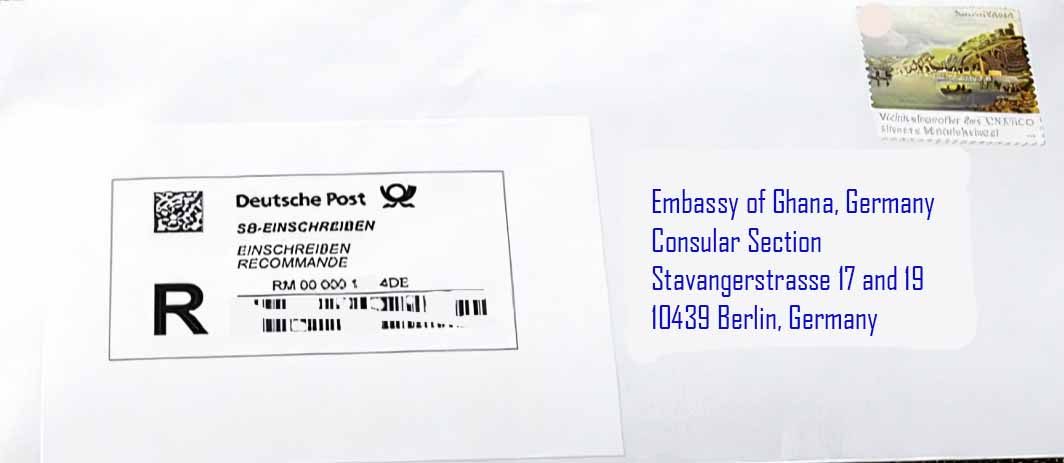
It has been observed that the dispatch of the Embassy’s mails bearing ordinary stamps are fraught with delays by Deutche Post.
2. In view of this, the Embassy wishes to advice all visa and passport applicants to use the Einschreiben or the Express services instead of the ordinary stamps when submitting self-addressed envelopes for delivery of requested services.
3. Meanwhile, the Embassy is negotiating with the authorities to address the challenges. We apologize for any inconveniences the situation may have caused.
4. Kind regards.
PUBLIC ANNOUNCEMENT
VACANT POSITION FOR THE HONORARY-CONSUL OF GHANA IN NORTH RHEIN WESTPHALIA
WE HAVE THE HONOUR TO ANNOUNCE THE VACANCY FOR THE POST OF HONORARY-CONSUL OF GHANA IN NORTH RHEIN WESTPHALIA. THIS VACANCY HAS ARISEN DUE TO THE DEPARTURE OF MR. KLAUS WEGENER, WHO RESIGNED EFFECTIVE FROM 31ST OCTOBER 2022.
CONSEQUENTLY, THE EMBASSY IS SEEKING APPLICATIONS FROM ELIGIBLE INDIVIDUALS FROM THE GHANAIAN COMMUNITY, AS WELL AS NATIONALS OF GERMANY WHO ARE IN GOOD STANDING AND EXHIBIT A KEEN INTEREST IN FOSTERING THE GHANAIAN COMMUNITY AND GERMAN PUBLIC RELATIONS.
ELIGIBILITY FOR THE POST ENTAILS THAT THE INDIVIDUAL MUST NOT BE OCCUPYING ANY SPECIFIC PUBLIC OFFICE IN GERMANY OR ANY OTHER NATION AND MUST POSSESS THEIR OWN OFFICE PREMISES TO OPERATE FROM. WE WISH TO EMPHASIZE THAT THE ROLE OF THE HONORARY-CONSUL IS VOLUNTARY IN NATURE, ENTAILING NO FINANCIAL REMUNERATION. THE TRUE MERIT OF THIS POSITION LIES IN THE HONOUR AND DIGNITY IT CONFERS UPON THE OCCUPANT. THE CRITERIA FOR THE POSITION CAN BE FOUND IN THE ATTACHED DOCUMENT.
THE EMBASSY ANTICIPATES THAT THIS COMMUNICATION WILL ENCOURAGE INDIVIDUALS WHO MEET THE CRITERIA AND POSSESS A GENUINE INCLINATION TO SERVE THE GHANAIAN GOVERNMENT, THE GHANAIAN COMMUNITY, AND THE GENERAL PUBLIC TO APPLY. APPLICANTS ARE REQUESTED TO FORWARD THEIR CURRICULUM VITAE, AN APPLICATION OR COVER LETTER, AND COPIES OF EDUCATIONAL CERTIFICATES TO THE EMBASSY VIA EMAIL AT BERLIN@MFA.GOV.GH THESE DOCUMENTS WILL BE SUBJECTED TO EVALUATION, SELECTION, AND INTERVIEW PROCESSES.
WE GREATLY VALUE AND RELY UPON YOUR CONTINUED COOPERATION. ON THIS OCCASION, THE EMBASSY ALSO DESIRES TO CONVEY ITS WELL WISHES TO ALL MEMBERS OF THE GHANAIAN COMMUNITY IN THEIR PURSUITS. WE WISH TO REASSURE OUR COMMITMENT TOWARDS SERVING THE INTERESTS OF THE COMMUNITY AND ADVANCING ITS WELL-BEING.
EMBASSY OF GHANA BERLIN
13th July, 2023
CRITERIA FOR THE APPOINTMENT OF HONORARY CONSULS
To be considered for appointment as Honorary Consul, the person should:
- Be a citizen of the Host Country or a Ghanaian with a permanent resident status in that country and in lawful occupation. A citizen of a third country would be ineligible for consideration.
- Accept to serve for a period of five years with the possibility of a renewal based on satisfactory performance and good conduct.
- Not be an Honorary Consul of any other country.
- Not hold any elective office in the Host Country.
- Be of good physical and mental health, resourceful and demonstrate a strong desire to serve the interests of Ghana.
- Be of unblemished character and enjoy respect in the Host Country.
- Have a wide, well-developed network of contacts among the political class, private sector, police and other security agencies. If a Ghanaian, should be fluent in the Host Country’s official language(s) where the languages(s) is not English.
- Maintain an office space suitable to provide consular services.
- Accept that the position is non-salaried.
- Possess good inter-personal and administrative skills to manage the Consulate efficiently and with integrity.
- Accept to follow the financial Guidelines for the operation of Honorary Consulates.
- Accept to submit Quarterly Operational Reports to the Supervising Mission.
- Be Familiar with the provisions of the Vienna Convention on Consular Relations, 1963 particularly Chapter III.
PUBLIC ANNOUNCEMENT – DORTMUND
VISA, PASSPORT & OTHER CONSULAR SERVICES
You are kindly informed that all consular services offered at the Honorary Consulate of Ghana in Dortmund (Steinstraße. 48, 44147 Dortmund) have been suspended until further notice. Consequently, all customers who wish to access visa and other consular services in Dortmund are requested to apply for these facilities through the Embassy in Berlin. Any inconvenience caused is deeply regretted.
BERLIN 08TH. NOV.2022
PUBLIC ANNOUNCEMENT
USE OF GHANA CARD FOR
ALL FINANCIAL TRANSACTIONS
Further to the Government of Ghana’s directive that the Ghana Card shall be the only identification card that will be used to undertake transactions at all Bank of Ghana licensed and regulated financial Institutions, Non-resident Ghanaians, who are yet to obtain a Ghana Card, are, however, required to present their passports for transactionary purposes with the financial Institutions.
The Government of Ghana through the National Identification Authority (NIA) and Identity Management Systems (IMS) will deploy systems at Ghana Embassies and Consulates abroad to register Non-resident Ghanaians for the Ghana Card in due course.
PRESIDENT NANA ADDO DANKWA AKUFO-ADDO IN MARBURG, GERMANY FOR THE VACCINE EQUITY FOR AFRICA CONFERENCE
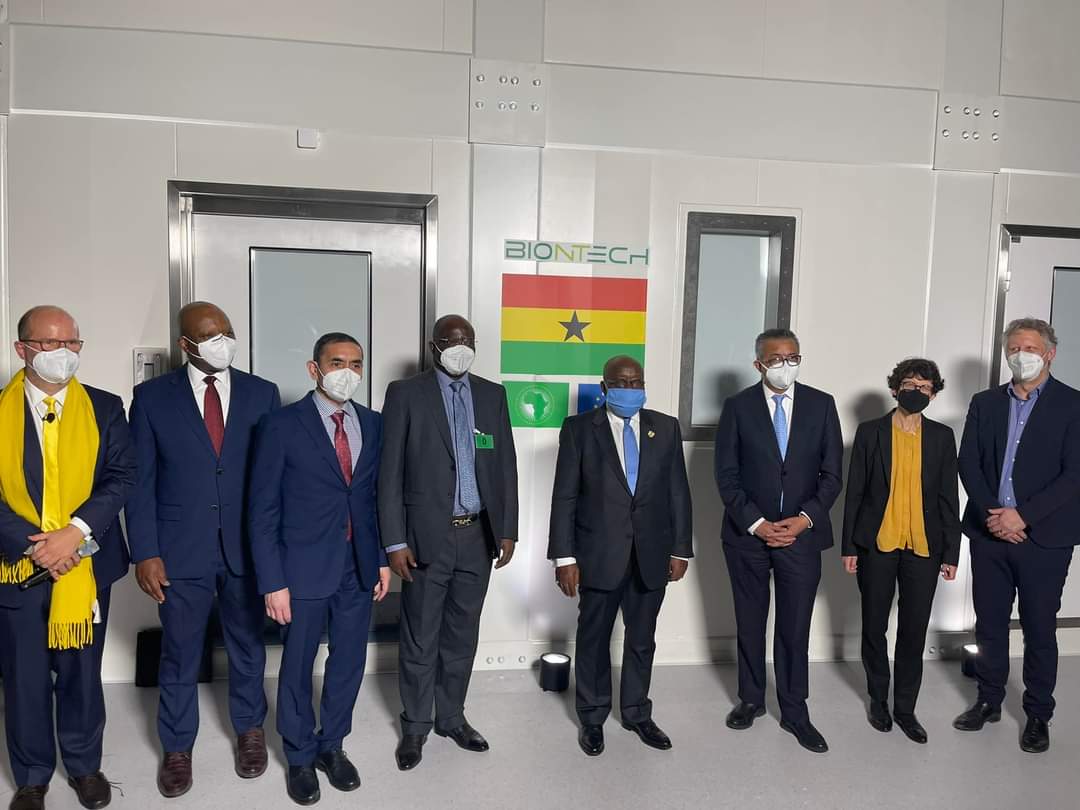
His Excellency the President Nana Addo Dankwa Akufo-Addo on 16th February 2022 joined his colleague Presidents, Excellencies Macky Sall of Senegal and Paul Kagame of Rwanda, to participate in the Vaccine Equity for Africa launch event in Marburg, Germany.
The launch event, a precursor to the AU-EU Summit, marked an important milestone for Europe, Africa, and its people and a important step in the quest for global vaccine equity.
At the event, Ghana, Rwanda and Senegal, entered into a joint partnership with German biotechnology company, BioNTech SE, to manufacture, fill, finish, and package BioNTech mRNA vaccines for COVID-19, Malaria and Tuberculosis in Africa.
It is a first step in the value chain of domestic vaccine production which will improve vaccine supply in Africa. The first modular vaccine production facility (BioNTainer) is expected to be shipped in mid-2022. BioNTech will ship BioNTainers to Rwanda and Senegal, and Ghana will support the manufacturing with fill-and-finish capacities. Commercial production of vaccines is expected to begin in 2023.
Vaccines manufactured in these facilities are expected to be dedicated to domestic use and exported to other Member States of the African Union at a not-for-profit price.

PROMOTIONAL VIDEO ON GHANA’S ECONOMIC LANDSCAPE AND INVESTMENT OPPORTUNITIES
GHANA'S AMBASSADOR TO GERMANY CALLS ON THE DEPUTY CEO OF GIPC IN ACCRA
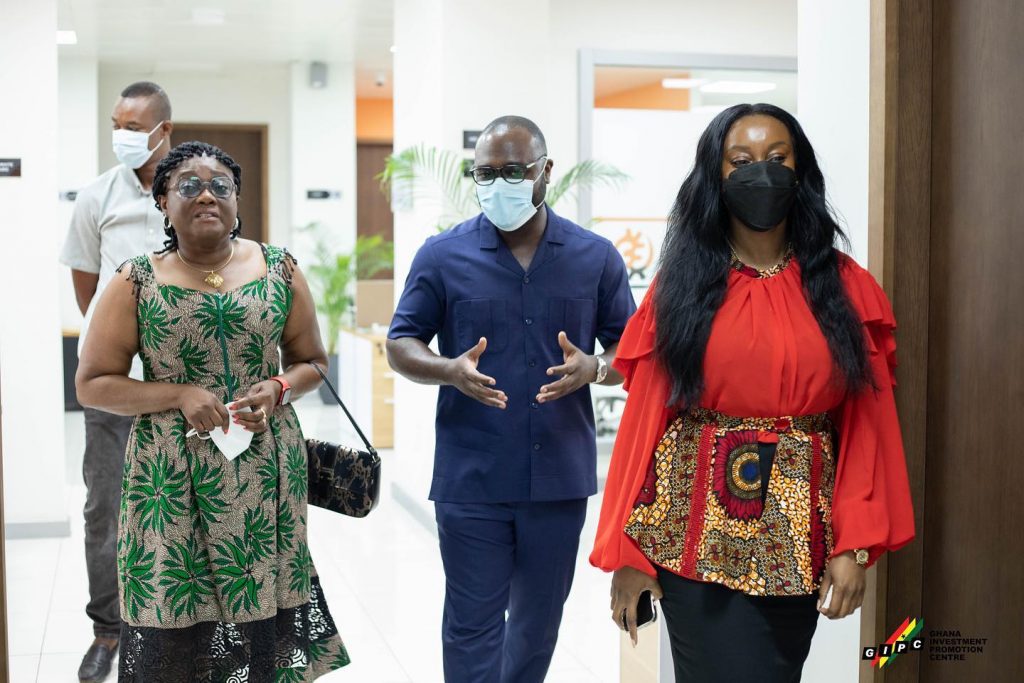
The Deputy CEO of GIPC, Mr. Yaw Amoateng Afriyie, today hosted Ghana’s Ambassador to Germany, H. E. Gina Ama Blay. They had a fruitful discussion, touching on the value of partnerships and how Ghana and Germany can further depeen trade and investment ties. The GIPC’s Diaspora Investment Desk and Research Team were also present to offer suggestions on how Ghana can better engage with the German diaspora. H.E. Gina Blay commended the Centre for its efforts and impressive working environment.




THE YEAR 2020 AMB. GINA BLAY

AMB. GINA BLAY AWARDED OUTSTANDING AMBASSADOR FOR THE YEAR 2020
On 3rd September, 2021, Ghana’s Ambassador to Germany H.E. Gina Ama Blay received the Outstanding Ambassador of the Year 2020 award at the 8TH edition of the Made-In-Ghana Awards and Exhibition, which took place at the Movenpick Ambassador Hotel in Accra.
The Made in Ghana Awards 2021 is about recognizing and celebrating Ghanaian personalities, high quality products, and Ghanaian-owned organisations, culture, art and tourism in an effort to create awareness and promote Ghana.
The Made-in-Ghana Awards 2021 is an initiative of Entrepreneurs Foundation of Ghana (EFG) and endorsed by the Ministry of Tourism, Arts and Culture and Ghana Standards Authority. Award winners were honored at a gala dinner in Accra on the theme ‘Building Ghanaian Brands to Compete in a Global Market’, under the distinguished patronage of Dr. Ibrahim Mohammed Awal, Minister for Tourism, Arts and Culture as the Special Guest of Honour.

Amb. Gina Blay with Ghana’s Minister for Tourism, Arts and Culture, Dr. Ibrahim Mohammed Awal

Group picture with diplomats and award winners
OFFICIAL VISIT OF H.E. PRESIDENT NANA ADDO DANKWA AKUFO-ADDO TO GERMANY, 22nd TO 28th AUGUST, 2021
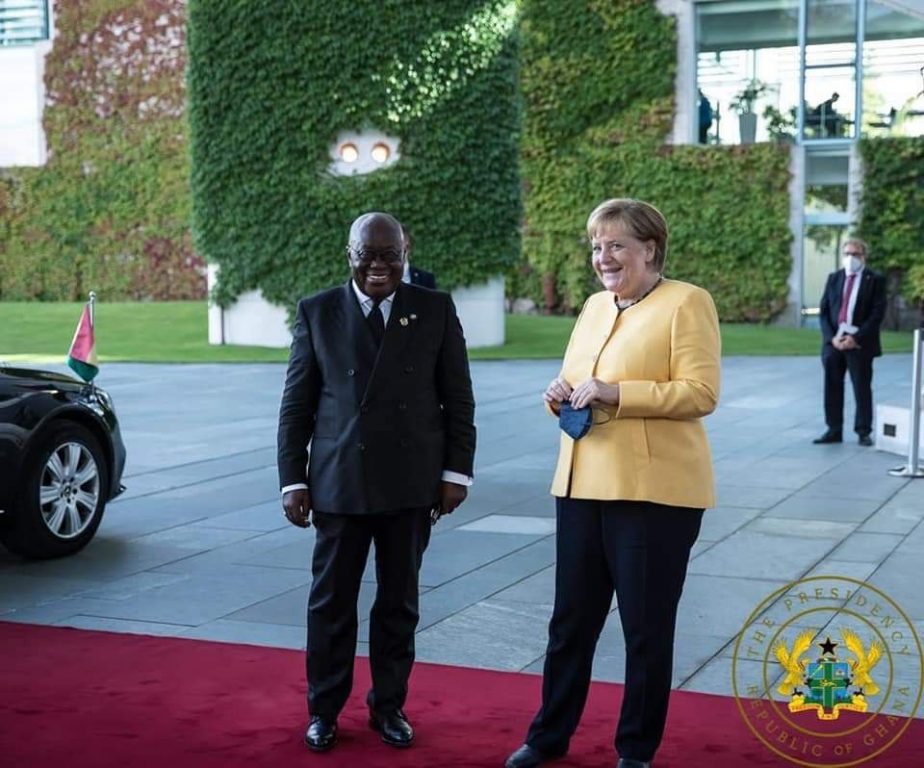
His Excellency the President Nana Addo Dankwa Akufo-Addo on 22nd of August 2021 embarked on an official visit to the Federal Republic of Germany at the invitation of the German Chancellor, Angela Merkel. The President was accompanied by the Minister of Foreign Affairs and Regional Integration, Hon. Shirley Ayorkor Botchwey and officials from the Presidency, Ministry of Foreign Affairs and Regional Integration, Ministry of Trade and Industry, Parliament, Ghana Investment Promotion Centre, Ghana Free Zones Authority as well as the Economic Management Team.
The President of the Republic, His Excellency Nana Addo Dankwa Akufo-Addo was the special guest of honour for the 75th Anniversary of the State of North Rhine Westphalia in Dusseldorf. The President also attended the opening of the North Rhine-Westphalia Academy for International Affairs, whose core purpose is to foster research at the highest level and promote the growth of international and interdisciplinary networks.
Read more on this topic… HERE
Setting Up Business in Ghana

|
PUBLIC NOTICE DUAL NATIONALITY
STRICT ADHERENCE TO COVID-19 PCT TEST RESULTS CERTIFICATE VERIFICATION
PUBLIC NOTICE
STRICT ADHERENCE TO COVID-19 PCT TEST
RESULTS CERTIFICATE VERIFICATION
In view of the rising cases of covid-19 positive test results at the Kotoka International airport, all potential travelers are to strictly observe the following:
- All travelers are to use the UNDP-Supported global heaven partnership site (globalhaven.org) for covid-19 certificate verification.
- All travelers are strongly encouraged to sign up for accounts on panabios.org with the same e-mail address and mobile numbers they provided the laboratories during testing.
- Passengers, who do not comply, will not be allowed to enter the Republic of Ghana.
READ MORE ABOUT COVID-19
EMBASSY OF GHANA
BERLIN
28th April, 2021
PROCEDURES ON OBTAINING TAX IDENTIFICATION NUMBER (TIN) ABROAD
PUBLIC NOTICE
PROCEDURES ON OBTAINING
TAX IDENTIFICATION NUMBER (TIN) ABROAD
Following representations by some Ghanaian citizens abroad on the difficulty in acquiring their tax identification numbers (hereinafter named TIN), the Ministry wishes to furnish below the necessary steps
required for access to a TIN under the taxpayers identification numbering system Act 2002, (ACT632):
(a) Applicants should visit the Ghana Revenue Authority (GRA) website at gra.gov.gh;
(b) Download the TIN form to complete and sign it;
(c) Scan the completed form together with a clear copy of one of the following ID cards;
• A valid passport
• Driver´s license
• Ghana voter card
• National identification card
(d) Forward the completed TIN form and scanned ID card to the GRA´s contact person:
Nana Mensah Otoo (Esq.)
(Principal Legal Officer in Charge of
Treaties and International Agreements)
Via email address: nana.otoo@gra.gov.gh
(e) Upon receipt of the completed documents, the GRA will revert with the relevant TIN number to the applicant.
2. For companies, applicants will need documents such as:
* Certificate of incorporation
* Commencement of Business certificate
* Partnership certificate
* External company letter
3. Acquisition of a Tin is free of charge. It is a prerequisite for the discharge of one´s tax obligations, particularly for every person liable to pay tax, or required to withhold tax at source (see Section 4 of the TIN system Act 2002, (Act 632).
4. For the avoidance of doubt, under section 8 of Act 632, without a TIN one shall not be permitted to do the following:
“(i) To clear any goods in commercial quantities from any ports or factory;
(ii) To register any title to land, interest in Land or any document affecting land;
(iii) To obtain any tax clearance certificate from the Internal Revenue Service, Customs Excise and Preventive Service or the Value Added Tax Service;
(iv) To obtain a certificate to commence business or a business permit issued by the Registrar-General or a District Assembly;
(v) To receive payment from the Controller and Accountant-General or a District Assembly in respect of a contract for the supply of any goods or provision of services unless that person quotes the TIN issued in respect of that person under the system.”
5. Besides, a TIN is required for the registration of vehicles and acquisition of passports and driver´s license.
EMBASSY OF GHANA
BERLIN
28th April, 2021
YOUR PASSPORT TO INVEST IN GHANA
A GUIDE TO DOING BUSINESS IN GHANA
The Embassy of Ghana wishes to share an e-brochure captioned‚ “Your Passport to Invest in Ghana”. The e-brochure was designed by the Ghana Investment Promotion Centre (GIPC), Ghana’s foremost investment attraction and promotion agency.
The digital publication provides salient and basic information on Ghana in general, procedure for setting up a business as well as investment opportunities and incentives.
Kindly access the document by clicking HERE :
EMBASSY OF GHANA
BERLIN
7 April, 2021

H.E. Nana Addo Dankwa Akufo-Addo
President of the Republic of Ghana
UPDATED COVID-19 GUIDELINES FOR KOTOKA INTERNATIONAL AIRPORT IN ACCRA, EFFECTIVE 8TH FEBRUARY, 2021

PUBLIC NOTICE
UPDATED COVID-19 GUIDELINES FOR KOTOKA INTERNATIONAL AIRPORT IN ACCRA, EFFECTIVE 8TH FEBRUARY, 2021
Kindly refer to the Embassy’s earlier communication on the COVID-19 Guidelines at the Kotoka International Airport, and find below updated guidelines for entry into Ghana, effective 8th February, 2021.
- Arriving Passengers
All international arriving passengers, including those from the ECOWAS region, will be required to meet the following health requirements prior to admission into Ghana:
a) Passengers must not have symptoms suggestive of COVID-19 including body temperature >38 degrees Celsius.
b) Passengers must possess a negative COVID-19 PCR test result from an accredited laboratory in the country of origin.
c)The test should have been done not more than seventy-two (72) hours before the scheduled departure from the country of origin.
d)Airlines who board passengers without PCR test result or transport and disembark passengers with positive PCR test result into Accra will be fined US$3,500.00 per passenger.
- Non-Ghanaians may be refused entry and returned to the point of embarkation at a cost to the Airline.
- Ghanaians will be allowed entry but subject to 14 days of mandatory quarantine at a facility approved by the Government and at a cost to the passenger.
e) Arriving passengers will undergo temperature screening.
f) Ghanaian residents who depart Ghana and return within one (1) week will not be required to present a COVID-19 result from the country of departure. They will, however, undergo a mandatory COVID-19 testing upon arrival in Ghana.
g) Passengers will be subjected to a mandatory COVID-19 test at the airport terminal, at a cost to be borne by the passenger as indicated below: Ghanaians and ECOWAS Citizens- $50 US dollars. All Other Passengers-$150 US dollars
Payment MUST be made online at https://myfrontierhealthcare.com/Home/Ghana and proof of payment (receipt) shown to Airline before boarding.
h) Ailines who board passengers without proof of payment for the COVID-19 test and would/could NOT pay for the test in Ghana, will be fined US$3,500 per passenger.
- Non-Ghanaian passengers may be refused entry and returned to the point of embarkation at a cost to the Airline.
- Ghanaian passengers will have their passports seized, the passenger handed over to the State Security Agencies and taken into a fourteen (14) day quarantine at a designated location at the passenger’s cost.
i) All arriving passengers who test positive for COVID-19 will undergo mandatory isolation and treatment at a designated health facility or isolation Centre, at a cost to passengers, EXCEPT Ghanaian citizens. The isolation will be for a period of seven (7) days. However, the final discharge of cases will be based on existing case management guidelines and protocols.
j) All passengers who test negative for COVID-19 will be required to continuously adhere to COVID-19 safety protocols and will receive regular information on COVID-19 within five (5) days of arrival in Ghana.
k) For passengers who transit through other countries before arriving in Ghana, the first country of departure will be the reference point. (Connecting flights should not deny passenger boarding, as long as the journey has not been terminated in any of the transit countries).
Transit Passengers
a) Passengers transiting and transferring through Accra will not be required to take the COVID-19 test in Accra.
b) Transit passengers will be required to adhere to COVID-19 testing requirements for the destination countries.
Exemptions
a) Airline crew are exempted from the pre-departure and arrival COVID-19 testing and should follow the Airline policy for testing.
b) Children under five (5) years of age will not be required to undergo testing on arrival at the Kotoka International Airport.
c) Passengers who arrive under emergency circumstances such as diverted flights will not be required to undergo testing if they do not leave the airport or remain in isolation in their hotel.
d) Children between the ages of 5-12 years will be required to pay for testing at the new rates (refer to no. 1g).
Passengers must wear face mask appropriately (extending from the middle nasal bridge to halfway between the chin and neck) and are advised to regularly use any of the hand sanitizing stations provided in the terminal.
Travelling with Pets
Travelling with pets into Ghana is allowed in line with guidelines of the Veterinary Services Directorate of the Ministry of Food & Agriculture.
Departing Passengers
All international departing passengers will be required to meet the following guidelines prior to departure:
a) Passengers will be required to adhere to COVID-19 testing requirements for the destination countries.
b) Departing passengers will undergo temperature screening at the entrance of Terminal 3 departures.
c) Only passengers and persons with business in the terminal will be allowed entry.
d) Online check-in or the use of self-service kiosks is strongly encouraged to reduce physical contact at the airport.
e) Passengers are advised to arrive at the airport at least 4 hours before the scheduled departure time.
Passengers must wear face mask appropriately (extending from the middle nasal bridge to halfway between the chin and neck) and are advised to regularly use any of the hand sanitizing stations provided in the terminal.
EMBASSY OF GHANA BERLIN
2nd February.2021
CORONAVIRUS UPDATES
Our Address
Embassy of Ghana, Germany
Chancery Section
Stavangerstrasse 17 and 19
10439 Berlin, Germany
P: (+49) 30 54 71 49-0
F: (+49) 30 44 67 40 63
E-Mail:
Please Click Here for Email with Subject
Embassy of Ghana, Germany
Consular Section
Stavangerstrasse 17 and 19
10439 Berlin, Germany
P: (+49) 30 54 71 49-50
F: (+49) 30 44 67 40 63
E-Mail:
Please Click Here for Email with Subject
 English
 Danish
 German
 French
 Spanish
 Italian
 Portuguese
 Estonian
 Lithuanian
 Latvian
 Swahili
 Dutch
Dutch Arabic
 Swedish
 Ukrainian